
Germany and the Netherlands have suspended their military preparing programs in Iraq due to an apparent security danger in the wake of rising US-Iranian strains in the area.
The declarations came after the US government office in Baghdad requested everything except crisis staff to leave Iraq. No subtleties of the alleged security danger were given.
A German guard service representative, Jens Flosdorff, said that by stopping its little scale preparing missions north of Baghdad and the Kurdish district of northern Iraq, Germany was "situating itself toward our accomplice nations, which have made this stride".
Be that as it may, Flosdorff said the move was not a reaction to a "solid danger" yet rather to a general security circumstance being seen as progressively tense.
The Dutch open telecaster, NOS, detailed that the nation's 50-in number mission, for the most part engaged with preparing Kurdish contenders, had been stopped "until further requests", yet cited a resistance service representative as saying he couldn't expand on the idea of the danger.
German and Dutch authorities did not react to demands for input on Wednesday morning. Neither one of the countries has pursued the US precedent and pulled back representatives from their international safe havens in Iraq.
In their open proclamations, European capitals have commonly voiced nervousness at the rising US-Iranian strains, however European negotiators overwhelmingly accuse the Donald Trump organization for trying to incite a showdown. US partners have prominently abstained from reverberating US cases of an up and coming danger from Iran.
The UK and US military have given strikingly various perspectives on the security circumstance for alliance powers in Iraq and Syria. The UK protection service remained by British Maj Gen Christopher Ghika, who was reprimanded by US headquarters on Tuesday for demanding there was no expanded risk from Iranian-adjusted volunteer armies in the locale.
"Maj Gen Ghika talks as a military officer in the US-drove alliance concentrated on the battle against Daesh [Isis] in Iraq and Syria. His remarks depend on the everyday military tasks and his sole center is the suffering thrashing of Daesh," the service said in an announcement, which did not legitimately address the subject of whether the security risk had expanded.
"He clarified in his Pentagon instructions that "there are a scope of dangers to American and alliance powers in this piece of the world. There dependably have been, that is the reason we have a powerful scope of power security measures. The UK has for quite some time been clear about our worries over Iran's destabilizing conduct in the locale."
The New York Times on Wednesday cited an anonymous American official as saying an expanded Iranian risk seemed to be "little stuff" that did not justify the military develop pushed by the national security guide, John Bolton. The authority said "a definitive objective of the year-long monetary approvals battle by the Trump organization was to draw Iran into an equipped clash with the United States", as indicated by the report.
Democrats in Congress have raised comparable concerns, indicating the parallels between the present US activities and the development to the 2003 attack of Iraq, in which Bolton assumed a supporting job.
"Iran is and has been for quite a long time a vindictive on-screen character and a state patron of dread," Adam Schiff, the director of the House insight advisory group, told the Washington Post. "But on the other hand I'm gravely worried about moves made by the organization that seem determined to put us on a crash course."
As of late there have been damage assaults against oil tankers, two of them Saudi-possessed, in the Persian Gulf, and Houthi revolts in Yemen asserted duty regarding ramble strikes against Saudi oil establishments. The Houthis get backing from Iran yet most specialists state they are not straightforwardly controlled from Tehran.
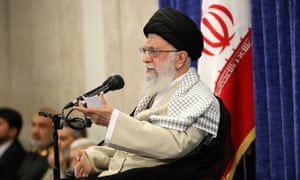
Iran's incomparable pioneer, Ayatollah Ali Khamenei, demanded that "nobody is looking for war", yet in a similar discourse he likewise discounted exchanges with the US, saying such talks would be "poison" – a clear reaction to Trump's recommendation that the Iranian authority call him legitimately.
Khamenei likewise rehashed Iran's danger to enhance uranium past as far as possible concurred in a multilateral atomic arrangement in 2015, which Trump revoked a year ago, on the off chance that US doesn't facilitate its oil ban and different assents. He clarified Iran could even go past its past limit of 20% improvement, past which it turns out to be progressively simple to achieve weapons grade, above 90%.
0 comments:
Post a Comment