
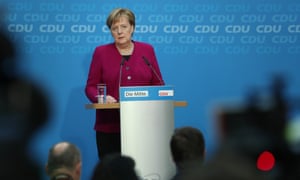
In the course of recent years I've gotten numerous calls from the British media asking me whether Angela Merkel had at long last gotten a knockout blow. What's more, I've generally answered: she's down however not out. Presently, in any case, she's downtrodden. Her gathering's heavy hitters have constrained her to report that she won't keep running for the administration of the Christian Democratic Union (CDU) at their meeting in December. At the season of composing, she needs to remain chancellor. In any case, around this time one year from now at the specific most recent, she'll be out of that activity, as well.
Sunday's decisions in the province of Hesse were the final irritation that will be tolerated. The CDU lost 11.7 rate purposes of the votes in a challenge commanded by national issues. Somewhere in the range of half of voters surveyed said they needed to send a "dissent message" to Berlin. The message has been gotten. Merkel's gathering is scrambling to desert her.
It's late in the day. In the general decision in September 2017 Merkel's CDU and its Bavarian sister the CSU (alluded to on the whole as "the Union") lost 8.6% contrasted and 2013. The Union's misfortunes were proportionate to the additions of the extreme right Alternative für Deutschland (AfD). Numerous inside the CDU required the gathering to return to a more preservationist profile. Be that as it may, Merkel did the inverse, endeavoring to cobble together a "Jamaica" alliance with the Greens and the dissidents of the Free Democratic Party (FDP). At the point when the FDP left the discussions, Merkel needed to proceed with the "amazing alliance" with the Social Democrats (SPD), which neither side extremely needed. From that point forward, the Union and the SPD have been discharging cast a ballot, while the AfD have figured out how to pick up seats in every one of the 16 provincial parliaments and additionally the Bundestag.
With the nation moving to one side, the cure appears to be straightforward: the Union needs to pursue. Yet, in territorial races in Bavaria prior this month, the CSU, which had attempted quite recently that, were clobbered, as well. Individuals who have deserted the Union for the extreme right are not going to be won back effectively. Then again, youngsters are voting in favor of the Greens, though the AfD is as yet a gathering of displeased old white men. So if the Union moves so far to the correct that an alliance with the ascendant Greens ends up unimaginable, Merkel's successor may discover him or herself in a circumstance where the main reasonable alternative is a coalition with the AfD.
The Austrian chancellor, Sebastian Kurz, has demonstrated that an administration can be shaped along these lines: his People's gathering is administering with the extreme right Freedom party. However, Germany isn't Austria. Given the AfD's wariness towards the Euro and the EU, as well as towards Nato and "globalism", a conservative coalition of the CDU and the AfD would be an existential peril for the western collusion.
Merkel has been prepping Annegret Kramp-Karrenbauer (AKK, as her admirers call her) as her successor. AKK originates from Saarland, sandwiched among Germany and France, which generally delivers ace European government officials. As a Catholic of the Pope Francis stripe, AKK joins social conservatism with liberal migration approaches and a worry for the "assurance of creation" which enabled her to shape the primary "Jamaica" alliance with the FDP and the Greens when she was serve leader of Saarland. AKK would be an image of coherence, yet in a post-Merkel CDU that could possibly be a risk.
Friedrich Merz was an early loss of Merkel's ascent to influence, and he's been nursing his complaints for as far back as decade while profiting as an attorney. Merz, who has a splendid personality and extraordinary explanatory capacities, is a monetary moderate and a lawfulness figure. He is a main light in Atlantik-Brücke, a system of master American business pioneers, legislators and media individuals. As it were, he is a return to the time of Helmut Kohl, and keeping in mind that this charms him to the gathering's old watch, there's a feeling of history repeating itself about his appointment that neutralizes him.
At last there's Jens Spahn, the publication kid of the CDU's young rightwingers. Spahn is gay and a shameless patriot, hitting out at Berlin coffeehouses where "no one communicates in German", regretting the "disturbance of the state" caused by Merkel's migrant strategy and the "counter gay, sexist and bigoted" demeanors he ascribes to foreigners from Arab nations. As Merkel's wellbeing clergyman he's been believed to perform well on issues, for example, care of the elderly. However, he has over and over and distinctly cosied up to Kurz, whom he sees as a good example. On the off chance that Spahn becomes party boss and after that chancellor, it could be a further advance in Germany's apparently unavoidable slide into patriotism. Not uplifting news for post-Brexit Europe.
0 comments:
Post a Comment