
"A few hills of individuals still remained where they had fallen, smashed down, and covered. A portion of these [were] as yet moaning … others, with gazing eyes, were wheezing for breath, and others could never inhale more … Persons may at some point be seen peeping from storage rooms and over the tall ridgings of houses, however they rapidly pulled back, as though frightful of being watched, or unfit to manage the full look of a scene so terrible and despicable."
The words are those of Samuel Bamford, the weaver, author and supporter of widespread suffrage who in August 1819 saw direct what history came to know as the Peterloo slaughter. The site in focal Manchester where it occurred, referred to in those days as St Peter's Field, is set apart by a plaque on the mass of what was at one time the Free Trade Hall yet is currently the city's Radisson lodging, a sumptuous flophouse I generally connect with swarms of drinking delegates at present day political gathering meetings. What number of bystanders ever gaze toward that small red circle and think about the terrible day when "a tranquil rally of 60,000 ace vote based system reformers, men, ladies and kids, was assaulted by equipped rangers bringing about 15 passings and more than 600 wounds"?
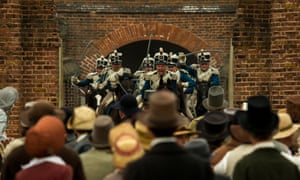
The slaughter's impending 200th commemoration is as of now being set apart by a bit of craftsmanship that reestablishes Peterloo's tissue, blood and crude interests as well as a distinctive feeling of what it says in regards to the nation where it occurred, both at that point and now. Mike Leigh's film Peterloo, discharged this Friday, is over two hours in length and unmistakably a work of adoration. It's excessively substantial on inconvenient exchange that makes even minor asides seem like political addresses, thus resolved to cover the broadness of its story that it loses any genuine feeling of human closeness. Be that as it may, on account of its delineation of a period of insurgency, war and monetary dejection, its inspiration of Manchester toward the beginning of the Industrial Revolution, and its stunning organizing of the slaughter itself, what it says most clearly is evident: this made a difference.
In the development to the film's discharge, there have been a couple of thunderings despite what might be expected. In a segment composed for the Times in August, the essayist and Conservative companion Daniel Finkelstein reacted to Leigh's request that Peterloo was "a noteworthy, significant occasion" and should be an obligatory piece of the national educational modules. Peterloo, said Finkelstein, "was not the start of anything much". England's cutting edge history, additionally, "was molded in plants and parliament and not in the city". He went on: "Mike Leigh is contending that since all understudies are educated around 1066, the Magna Carta, the spouses of Henry VIII, the French Revolution and Waterloo they should all find out about Peterloo. Furthermore, this proportionality is essentially off-base."
I am not an immense enthusiast of segments about different segments, yet this merits a reaction. Regardless of whether this current nation's moderate and erratic grasp of popular government began in "the road" is an unsettled issue, yet it positively happened on account of the weight applied by a perpetually drew in populace, and advancements that happened far from focuses of intensity. Individuals' requests for an important political voice extended back to the extraordinary growing of radical and profoundly libertarian believing that occurred in and around the English common war, and on to the mature on this side of the divert that flourished in the wake of the French Revolution: change social orders and political associations, ever-bigger open air gatherings, the substantial readerships that devoured Thomas Paine's Rights of Man and William Cobbett's week after week Political Register.
In that sense, Peterloo – the name, first composed as "Dwindle Loo", was authored by the manager of a week by week paper called the Manchester Observer – does not request consideration exclusively due to what occurred on one day, but since of an any longer story that encouraged into the occasions of 16 August 1819, and after that stretched out past them.
In his amazing book The Making of the English Working Class, EP Thompson quit wasting time: Peterloo, he expressed, "was without inquiry a developmental involvement in British political and social history". For AJP Taylor, the slaughter "started the separation of the old request in England". Regardless of whether the reaction of people with great influence to what happened was a dictator crackdown that joined with a financial rise to moderate the advancement of the change development, the slaughter uncovered the tangle of idiocy, support and debasement that go for the nation's arrangement of government – and started a long procedure of progress, as an undeniably politicized common laborers step by step discovered its voice.
'On account of the film's portrayal of a period of unrest, war and monetary wretchedness, and its astonishing organizing of the slaughter itself, what it says most clearly is this made a difference.' Photograph: Simon Mein
The establishment of this newspaper– at that point called the Manchester Guardian, and built up in the fallout of Peterloo to "warmly advocate the reason for Reform" – is a piece of this story. Chartism flared to life 15 years after the fact. Exchange associations inevitably started to get through during the 1850s; the development of the electorate was set apart by the entry of enactment in 1832, 1867, 1884, 1918 and 1928.
These progressions may have occurred at a frigid pace, yet not all that gradually that we can't look past their datelines and distinguish occasions that set the stage: the enormous gatherings that occurred in 1816 at Spa Fields in north London, and wavered into uproars; the "change riots" of 1831 in Bristol, Nottingham and Derby, and exhibitions around a similar time in London and Birmingham; the immense Chartist social affairs at Kersal Moor, in Salford, in 1838 and 1839; the last year's Newport Rising.
These things shape a sort of shadow history of nineteenth century Britain, which still has unreasonably little buy on this present nation's shared feeling of its past. Peterloo was pre-prominent among them, not minimum since it affirmed that reformers had an unanswerable good case, while the experts were uncovered as the safeguards of savage benefit. There is, additionally, another constantly ignored part of the way August 1819 opened a way to the future: the way that in the period paving the way to the slaughter, ladies' change social orders had jumped up around the north-west, shaped to help the battle for male suffrage, yet in addition in charge of the advancement of ladies casting a ballot close by men at radical get-togethers. They pulled in no closure of maltreatment, yet ladies reformers were disobediently on the stage at St Peter's Field. In a simply distributed book about the slaughter, the authentic essayist Jacqueline Riding says that what they did spoke to "the most punctual case of sorted out female movement in British legislative issues".
Peterloo likewise sparkles unflattering light on a portion of our laziest national legends. In the course of recent years or something like that, we have used to government officials portraying Britain – or England – as a nation that has dependably radiated "goodness, resilience and a feeling of reasonable play". By differentiation, Thompson saw 1819's massacre starting in "the frenzy of class disdain" and an imbued conviction that any common laborers swarm was in every case just a breath far from transforming into the horde – something that has routinely surfaced long into the popularity based age: witness Orgreave or Hillsborough. Another point, considerably more disregarded, is bound up with a similar inclination of power to tip into mercilessness: the way that Peterloo saw the brutality dispensed by British colonialists out of the blue returning home, and indicated ahead a portion of the domain's bloodiest scenes.
One other exercise goes through Peterloo and its inheritance: the decision class isn't some ghost of lefty demonology, however a genuine article – and, even in the 21st century, its most fundamental highlights remain. Its driving lights are still miserably difficult and joined to the wonders of battling the last war. As prove by a long story that takes in everything from the neediness of the 1930s to the Conservative party's birthing and the blundering of Brexit, they should dependably get things terribly wrong before they are near getting them even half right.
Watching Leigh's film, there was a minute when some minor character was voicing reactionary assessments with flowery fake, and I immediately envisioned the previous remote secretary nowadays endeavoring to offer us some half-positioned vision of our national predetermination. Boris Johnson, truth be told, is an animal apparently culled from an animation by the Georgian craftsman George Cruikshank – and a man whose scandalous buy of German water gun while he was the chairman of London featured a dread of the horde that any understudy of the nineteenth century would perceive in a flash.
The sort of history that currently appears to rule our way of life is over and over again fixated on lords, rulers and ground-breaking men, something of late found in the recovery of the religion of Winston Churchill. Peterloo and everything that tailed it were the results of things that were significantly more significant: disjunctions between frameworks of intensity and the new modern economy, and the way that among the primary individuals to experience those logical inconsistencies and request their goals were the thousands who accumulated in St Peter's Field.
Put another way, this current nation's voyage into popular government was a result of the knowledge of groups. There, not in services and chateaus, is the place social advancement dependably begins, and in times as unverifiable as our own, we would do well to recollect it.
0 comments:
Post a Comment