
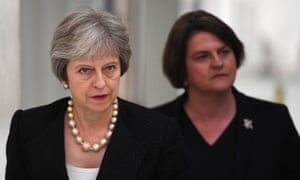
The Democratic Unionist party is characterized by its antagonistic vibe toward the Republic of Ireland. For the DUP the political emergency of Brexit has produced a unique chance to reclaim control of Northern Ireland. It appears that it will do this regardless of whether it involves obliterating the Good Friday understanding and opposing the desires of a considerable dominant part of its own electorate.
This is apparent from the comments of the gathering's pioneer, Arlene Foster, on the edge of the Tory party meeting this month. The 1998 understanding isn't "consecrated", she stated, and "could advance" into something other than what's expected with regards to the UK's takeoff from the EU. Cultivate additionally told a thoughtful daily paper how it was "profoundly baffling to hear individuals who casted a ballot remain and in Europe discuss Northern Ireland as if we can't contact the Belfast assention".
None of this ought to be at all astonishing. The present pioneers of the gathering established by Ian Paisley are characterized by the break he made with standard unionism over the Good Friday understanding – it is the DUP's fundamental distinguishing mark, the reason it has effectively pounded whatever is left of political unionism. Under its "authority" the declined structures of government made by that understanding have came to a standstill. What's more, to exacerbate the situation different cross-fringe activities, both cultivated by and formed since it became effective, are presently undermined by the hardest of hard outskirts that the DUP's Brexit devotees at Westminster (a faction inside a religion) appear to be resolved to grasp. The appointive lottery has granted the DUP a potential prize it appears to be resolved to guarantee. Ireland's annihilation is their triumph regardless of whether, similarly as with Shelley's Ozymandias, "nothing next to remains".
It has been accounted for that Theresa May declines to meet with Northern Ireland's non-unionist political delegates as a gathering. The four political gatherings that asked for a joint gathering – Sinn Féin, the SDLP, the Alliance, and the Green party – speak to a remain feeling in Northern Ireland that conveyed a solid vote in favor of the EU in the 2016 choice.
In the nearby decisions for the disastrous declined get together that followed in 2017, the DUP neglected to anchor a dominant part of voters inside the locale – it oversaw just 28% of first inclinations, as against the 51% consolidated aggregate of the four gatherings that the head administrator won't meet. In the general decision without further ado thereafter the offers were DUP 36%, the four half. The pioneer of the already authoritative Ulster Unionist party, Robert Swann, said a week ago that the DUP had taken unionism "into the canal". At his first gathering as pioneer the prior year he had cautioned that a "hard fringe" was impossible amid facilitated commerce arrangements, and that a gravely took care of Brexit made a "genuine risk of coming back to the legislative issues of the past".
Northern Ireland business concurs: neighborhood CBI seat Trevor Lockhart as of late wrote to May for the benefit of 21 signatory associations cautioning of the grave concern felt by business at the possibility of a no-bargain Brexit, now coming considerably more conceivably into view in light of the refusal of any trade off on the Irish stopping board – a position rendered immovable by DUP uncompromising nature. Lockhart, who concedes that he may himself need to move his business south to the Republic of Ireland, is evident that (as he told the Financial Times) the worries felt by business are "cross-sectoral and … cross-network". That point is additionally bore witness to by supposition surveying in the region distributed by Queen's University Belfast in July.
With its restriction to Brexit joining with its perspectives on the privileges of ladies, gay individuals and much else, the DUP without a doubt presents to numerous in Britain as a ludicrous return to a frightful time of partisan governmental issues and zealous response. Perspectives towards it in the Republic of Ireland are likely the equivalent; in fact the state has freed itself from a preservationist Catholic predominance whose social strategy needs are currently to be discovered (incongruity of incongruities) just inside the positions of the Rome-detesting DUP. It can't be expressed regularly enough this is likewise how the DUP present to a lot of in Northern Ireland also, maybe (as the numbers above demonstrate) even a greater part.
It was the seventeenth century Protestant evangelist Thomas Fuller who appears to have been the first to state that "the breaking point is simply before the day break". It has been so in the Republic, where response to a progression of dreadful occasions and disclosures about the past moved the nation to its more brilliant present. Brexit hosts pushed the non-unionist gatherings into essential dynamic collusions: on business, the fringe and rights (the remainder of these particularly powerless after Brexit). Might the emergency of Brexit be going to give Northern Ireland an opportunity to rise above the old green-orange partition?
May should meet with the Northern Ireland remain parties with a bigger number of votes than their DUP rivals, and toss in Lockhart and Swann for good measure. It will at any rate roll out an improvement from troubling trades of red lines with the 10 DUP MPs to which she is indebted. What's more, she may even have the capacity to detect an early Northern Ireland really taking shape: one that is hotter, more tolerant and associated with the desires of its kin than its alleged agents.
0 comments:
Post a Comment