
Up and down the rutted street running from Inn Din town to Maungdaw town in northern Rakhine express, the darkened, headless trunks of palm trees intersperse the lavish scene. A year after Myanmar's military propelled a battle of homicide, assault, and torching to drive out the Rohingya, the scorched trees are the main unmistakable updates that the stateless, Muslim populace once lived there. Before long, even these might be eradicated.
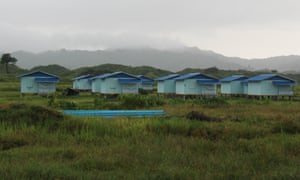
In Inn Din, as in different parts of Rakhine express, the Myanmar government is crushing regions where a large number of Rohingya lived before escaping to Bangladesh. Bulldozers and escavators are stopped alongside new, blue-roofed homes, worked by an administration organization led by state advisor Aung San Suu Kyi.
Amid a legislature composed media voyage through northern Rakhine state toward the end of last month, Inn Din town chairman Kyaw Soe Moe told the Guardian the new homes would before long be possessed by "Rakhine, Chin, Bamar, and Hindu individuals from different parts of the nation".
As per an UN truth discovering mission, whose report a month ago required Myanmar's military pioneers to be indicted for decimation, the reason for the bulldozing and development is "the evacuation of the Rohingya and all hints of them and their supplanting with non-Rohingya".
Another impact of the development blast is the demolition of physical proof that could be valuable in a future court. Médecins Sans Frontières (MSF) gauges no less than 6,700 Rohingya were slaughtered between 25 August and 24 September 2017, yet less than 100 bodies have been revealed, and the Myanmar government has pointed the finger at Rohingya agitators for everything except 10 of the killings.
"It's a central issue I ask myself – where are all the dead bodies?" said Chris Lewa, executive of the Arakan Project, which utilizes neighborhood systems to report maltreatment in Rakhine state. "After a year, in what capacity will we discover? On the off chance that we discover bones, in what capacity will we know how or when they were slaughtered, or whether they were executed by any stretch of the imagination?"
As the past is bulldozed, the future odds of a Rohingya return look grim. On the ground, endeavors to delete their authentic nearness have all the earmarks of being succeeding. Since Myanmar consented to an UN arrangement in June to repatriate in excess of 700,000 Rohingya displaced people, the administration has come no nearer to satisfying this commitment. UNHCR representative Andrej Mahecic said the organization "does not trust that conditions are right now set up in Myanmar for deliberate, protected, noble, and manageable return of Rohingya evacuees".
Kyaw Soe Moe, the chairman of Inn Din, stated: "I don't figure the Muslims will return. Nobody needs the fear based oppressors to return."
One slaughter, two stories
The obliteration of Rohingya lives has been joined by the eradication of their accounts. This year, Inn Din picked up ignominy when a Reuters examination uncovered that on 2 September, 2017, troopers, police, and Rakhine Buddhist villagers slaughtered 10 Rohingya men and young men. The disclosure was trailed by the conviction of seven fighters for homicide, and in addition the detainment of the two columnists who broke the story – Kyaw Soe Oo and Wa Lone.
A recently assembled 'normal town' for non-Rohingya pioneers south of Inn Din town.
This, in any case, isn't the story Inn Din inhabitants tell today. Khin Than Yee, 52, a Rakhine Buddhist whose home lies in a tranquil corner of the town, told the Guardian how she trusted a year ago's viciousness started. "The Muslim people group had been intending to assault the town for quite a while," she said. "Two Muslims slaughtered the dad of [Rakhine Buddhist villager] Tun Aye, and from that point forward, they started yelling and droning from the highest point of their mosque and consumed their own homes."
Her record looks somewhat like declarations shared by Rohingya outcasts with the UN truth discovering mission and universal media. Her reference to the dad of Tun Aye rehashes the military's case that Rohingya agitators slaughtered a Rakhine occupant of Inn Din on 25 August, 2017, which purportedly started the viciousness that finished in the slaughter seven days after the fact. As indicated by the reality discovering mission, there was no assault by Rohingya guerillas in Inn Din town that day.
At the point when gotten some information about the slaughter. Khin Than Yee developed eager, beating the floor as she stated: "For what reason would Rakhines execute Muslims? Muslims kill Rakhines 100 times more regularly than Rakhines kill Muslims. Rakhine individuals are benevolent."
Khin Than Yee's wariness copies the reflexes of Myanmar's pioneers. In her first open location on the Rohingya exile emergency in September 2017, while individuals were all the while gushing over the outskirt to escape military savagery, Aung San Suu Kyi scandalously stated: "We need to discover why this mass migration is going on."
Diligent as they might be, endeavors to sow question about the actualities won't offer any shelter, say specialists and lawful specialists. Christopher Sidoti, an individual from the UN truth discovering mission, told the Guardian he and his partners could gather enough observer and unfortunate casualty proof to arrange pre-arraignment briefs, which might one be able to day be utilized by examiners. "The [land] leeway is unquestionably wrecking proof, including of likely graves and locales of consuming bodies, yet it doesn't forestall responsibility on account of the extraordinary mass of other proof," Sidoti said.
A "free component" has likewise been set up by the UN human rights gathering to gather proof for a future council. Not at all like the reality discovering mission, which concentrated on proof that violations happened and were foundational, the free component will center around gathering "linkage" proof, which joins people to particular wrongdoings.
0 comments:
Post a Comment