
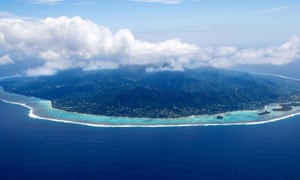
Times are changing in this once in the past ignored heaven as sightseers find the sustenance, swimming and particular culture
Here, at Aitutaki's most noteworthy point, the genuine greatness of the island's sprawling tidal pond uncovers itself. Its external edge surrounds the little island, part perfectly clear waters from the hurling dim blue of the Pacific past.
It loans the atoll – the second most crowded of the 15 Cook Islands – a demeanor of stillness.
"Entirely astonishing perspective, hello?," I say to an uncommon gathering of American voyagers we find at the highest point of the slope. "No doubt, unfathomable," one reacts, grinning.
Time on Aitutaki still moves with the sort of moderate, sluggish step missing to the more visitor thick island heavens, similar to Bali or Phuket. Just 2,000-odd individuals live on Aitutaki, and the network has been mindful so as to keep its long, arcing shorelines quiet, free from contamination or the western swarms.
It has a humble visitor exchange yet is a long way from invade. The resorts that are here, similar to the boutique Etu Moana manors, have been mindful so as to keep up the island's casual air. The exquisite rooms sit simply off the water, their covered rooftops tucked away among the palm trees. In the nighttimes, my accomplice and I sit on the veranda, mixed drinks close by, watching the sun bring down itself toward the skyline.
Our mornings are spent continuous, more often than not investigating the abounding reef, pursuing tropical fish til weariness. The waters, still as glass, light up with the reds of the angelfish and the yellows of the butterfly angle as they escape into woodlands of coral.
Waterfront manors
Facebook Twitter Pinterest The resorts in Aitutaki in the Cook Islands have been mindful so as to keep up the island's casual air, and the rich rooms sit simply off the water, their covered rooftops tucked away among the palm trees. Photo: James D Morgan/Getty Images
Out past the reef, among July and October, whales can be seen making their extraordinary relocation south, making a beeline for the warm Pacific waters to breed and conceive an offspring.
Shops in the principle town of Arutanga are relied on the digits of one hand, and autos are dwarfed by the number of inhabitants in felines meandering the island.
Somewhere else in the Cook Islands, times are evolving. Tourism is presently achieving record levels. A year ago 161,362 guests came here, the most abnormal amount in the country's history, and a development of 10% on the prior year.
Around 61% were New Zealanders. Australians (21,289) were the following greatest accomplice, trailed by Americans and Europeans. You see it most on Rarotonga, the Cooks most crowded island, where new resorts like the Moana Sands Lagoon resort are springing up, apparently medium-term. Life moves at a quicker pace on Rarotonga, the capital of the Cook Islands. In any case, even Aitutaki, a hour's departure from Rarotonga, has not been invulnerable to change.
Eteta Fepuleai and her family have run a little takeaway eatery, Puffy's Beach Bar and Grill, on Aitutaki for just about 18 years. Puffy's is the best sort of takeaway joint. Unassuming, shabby and straightforward, it doesn't stray from what it specializes in: new fish, servings of mixed greens, burgers and chilly brew.
Be that as it may, when Fepuleai started, it was one of the main takeaways here. Throughout the years contenders have jumped up as more sightseers searched out Aitutaki's heaven. "It's changed a considerable measure," she says. "A ton of organizations contrasted with us, a considerable measure of takeaways have come up. I don't generally stress, in light of the fact that everybody knows us. They know the manner in which we cook."
Fepuleai consumed quite a bit of her time on earth in adjacent New Zealand, before coming back to her place of birth. It is anything but a remarkable story.
Inquisitively, there are more Cook Islanders in New Zealand than in the Cook Islands. Be that as it may, increasingly are returning home. Most return to Rarotonga.
Like Tupou Metutaopu, a New Zealander whose guardians were conceived in the Cook Islands. He returned to Rarotonga five years back to reconnect with his underlying foundations. Metutaopu presently enables group for Koka Lagoon To voyage, an organization that runs glass-bottomed vessels in the waters off Rarotonga.
"Local people who used to live here are returning," Metutaopu says. "I'm from New Zealand, brought up in Wellington. My mum and father are from here."
Metutaopu is addressing me while remaining in the shallows of Muri shoreline as he empties the pontoon in the wake of completing a long morning on the water. We'd quite recently spent a large portion of the day on the tidal pond voyage, which weaves its way through the reef before making landfall on one of the islands scattered off Rarotonga's eastern drift for lunch.
Close to pushing off, hand drums and wood-cut ukuleles appear in the hands of the group. The music is a diverse blend of customary Polynesian tunes and western pop hits, all set to the fast, splendid strum of the ukulele.
We're on the first of two day by day travels kept running by Koka. A significant part of the voyage is spent in water, investigating the reef, and looking as the team endeavor to draw Roger, an incomprehensibly substantial eel, from his concealing spot in the coral. When we stop at a uninhabited island for lunch – a crisp fish grill – one of the group expertly ascensions to the upper spans of a palm tree, without a trace of dread, to recover new coconuts. They make a demonstrate to of instructing voyagers generally accepted methods to open the gather and utilize the drain or oil inside. We're encouraged how to mesh coconut leaves into a crate, and how to tie a sarong in the conventional style.
0 comments:
Post a Comment